In this articleShowHide
- 01How refrigerant works in your AC
- 02Signs your AC may need gas filling
- 03Why the leak must be found before any refill
- 04The correct AC gas filling process, step by step
- 05R32, R410A and R22: refrigerant types explained
- 06Questions to ask before agreeing to a refill
- 07AC gas charging in Bhubaneswar, Cuttack, Puri and Khordha
"The gas is finished" is probably the most common diagnosis Odisha households hear when an AC stops cooling. Sometimes it is correct. Often it is not. And even when the gas really is low, AC gas filling on its own rarely solves the problem, because refrigerant does not burn off or get used up like fuel. If it is low, it has leaked out — and it will leak again unless the leak is fixed.
This guide explains the genuine signs of low refrigerant, the correct step-by-step gas charging process, the refrigerant types you will find on ACs in India, and the questions worth asking before you agree to a refill.
How refrigerant works in your AC
Refrigerant circulates in a closed copper loop between the indoor and outdoor units. In the indoor coil it absorbs heat from your room and evaporates; the compressor pumps it outside, where the condenser releases that heat and the refrigerant turns back into liquid. The same charge goes round and round for the life of the AC. The amount is set by the manufacturer for each model, and both too little and too much reduce cooling.
Signs your AC may need gas filling
None of these signs alone proves low gas, but several together are a strong hint:
- Cooling that drops gradually over weeks or months, rather than failing overnight.
- Frost or ice on the indoor coil, or on the thinner copper pipe at the outdoor unit.
- Air from the vents feels cool but not cold, even with clean filters.
- A hissing or bubbling sound near the indoor unit or pipe joints.
- Oily stains around flare nuts, valves or the outdoor coil — refrigerant oil escapes with the gas.
- The compressor runs for very long periods and electricity bills rise without any change in usage.
- Water dripping indoors as ice on the coil melts — see our guide on AC water leakage.
Rule out the simple causes first
Dirty filters, a clogged condenser or a failed outdoor fan can all mimic low gas. Our AC not cooling guide covers what to check before assuming a refrigerant problem.
Why the leak must be found before any refill
A refill without leak repair is money spent on gas that will end up in the atmosphere. In our experience, the usual leak points on split and window ACs are:
- Flare joints at the indoor and outdoor unit, especially after a hurried installation or relocation.
- Corroded condenser coils — common near the Puri coast, where salt air eats into copper and aluminium.
- Indoor evaporator coils with pin-hole leaks from formicary corrosion.
- Service valves and Schrader cores that were not tightened or capped.
- Pipes damaged by vibration, rubbing against walls, or rodents.
A technician confirms the leak using a pressure reading, soap-bubble testing at joints, an electronic leak detector, or a standing pressure test with dry nitrogen. Where the leak is accessible it can be brazed or re-flared; a badly corroded coil may need replacing.
Some leaks are slow enough that a single visit cannot pinpoint them. In that case a standing nitrogen test, where the system is pressurised and the gauge is watched over a longer period, shows whether pressure is falling and narrows down which section to check. It takes more time than a quick top-up, but it is the difference between fixing the AC once and calling a technician back every summer.
The correct AC gas filling process, step by step
Whether it is a repair or a new AC installation, proper gas charging follows the same sequence:
- Check the rating label on the outdoor unit for the refrigerant type and factory charge.
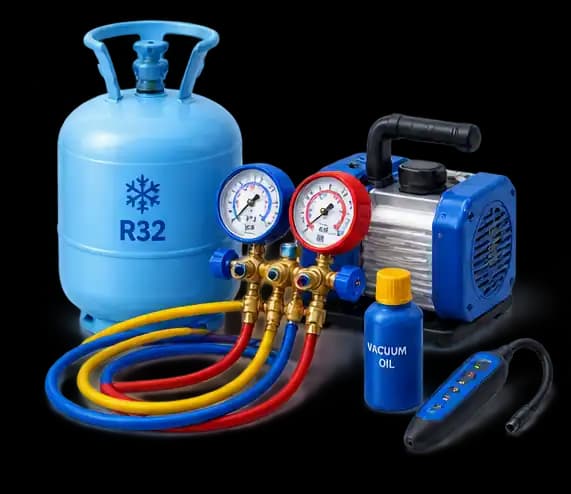
- Measure operating pressure with a gauge manifold and compare it with expected values for that refrigerant and the day's outdoor temperature.
- Locate the leak using bubble testing, a detector or a nitrogen pressure test.
- Recover any remaining refrigerant where required, then repair the leak by brazing, re-flaring or replacing the faulty part.
- Pressure-test with nitrogen to confirm the repair holds.
- Vacuum the system with a vacuum pump to remove air and moisture, and hold the vacuum to confirm there is no remaining leak.
- Charge the correct refrigerant by weight where possible, or by pressure and temperature readings for top-ups on a sealed system.
- Test performance — check suction pressure, the air temperature difference across the indoor unit and the compressor's running current.
Why vacuuming matters so much
Once the system has been opened, humid Odisha air — especially during the monsoon — gets inside. Moisture reacts with refrigerant oil to form acids, can freeze at the expansion device and block flow, and shortens compressor life. A proper vacuum pulls that moisture out. Purging with refrigerant from the cylinder is not a substitute, and on modern R32 and R410A systems it is poor practice.
Overcharging is as bad as undercharging
Adding extra gas "for better cooling" raises pressure, makes the compressor work harder and can flood it with liquid. The correct charge is whatever the manufacturer specifies — no more.
R32, R410A and R22: refrigerant types explained
Most ACs sold in India over the past several years use R32 or R410A. Older units, particularly window ACs and early splits, often run on R22, which is being phased out. Your AC's refrigerant is printed on the outdoor unit label.
| Refrigerant | Where you will find it | Things to know |
|---|---|---|
| R32 | Most newer split and inverter ACs | Single-component gas, efficient, mildly flammable — needs careful handling and correct tools |
| R410A | Many inverter splits, cassettes and VRF/VRV systems | Blend that runs at high pressure; should be charged as liquid to keep the mix correct |
| R22 | Older window and split ACs | Being phased out; availability is shrinking, so leak repair matters even more |
| R290 | Some newer models | Hydrocarbon gas, flammable; only charge with equipment and training suited to it |
Never mix refrigerants or convert an AC to a different gas without the manufacturer's guidance. Inverter models are especially sensitive to incorrect charge, because the controller adjusts compressor speed based on sensor readings — see our inverter AC troubleshooting guide for related faults.
Questions to ask before agreeing to a refill
- What was the pressure reading, and what should it be?
- Where is the leak, and has it been repaired?
- Will the system be vacuumed before charging?
- Which refrigerant does my AC use, and is that what you are charging?
- How much gas is being added — a top-up or a full charge?
AC gas charging in Bhubaneswar, Cuttack, Puri and Khordha
Our AC gas charging service follows the leak-first process above for split, window, inverter, cassette, ductable and package ACs. Technicians work across Bhubaneswar, Cuttack, Puri and Khordha, and we aim to reach you the same day. The diagnosis and cost are explained before work starts, with refrigerant and any parts quoted separately. If the cooling issue turns out to be electrical or airflow-related instead, the visit becomes a standard AC repair and you are told that upfront.
Frequently asked questions
Paras Refrigeration Service Team
AC service technicians, Bhubaneswar · Last reviewed 5 Oct 2026
Written by the Paras Refrigeration service team from day-to-day experience repairing, installing and maintaining residential and commercial AC systems across Bhubaneswar, Cuttack, Puri and Khordha.
- #AC gas filling
- #Refrigerant
- #Gas leakage
- #AC repair