
In this articleShowHide
An office AC works harder than almost any home unit. It runs ten or twelve hours a day, cools rooms full of people, computers and printers, and is expected to work every single weekday. When one fails in May, it is not just uncomfortable; meetings move, staff leave early and server cupboards overheat. Good office AC maintenance is about catching problems on your schedule rather than the AC's.
This checklist is the routine our technicians follow for offices across Bhubaneswar and Cuttack, adapted for split, cassette and ductable systems. Use it to brief your facility team, or as a yardstick when comparing maintenance contracts.
Why office AC maintenance needs its own routine
- Longer running hours: an office unit can clock in a few months what a bedroom AC runs in a year, so filters and coils foul faster.
- Higher internal heat: people and equipment add load, so a slightly dirty coil shows up as warm cabins much sooner.
- Ceiling-mounted equipment: cassette and ductable units are out of sight, so blocked drains and dirty filters go unnoticed until water drips onto a desk.
- Shared consequences: one failed unit in an open-plan floor puts extra load on the neighbouring units.
The office AC maintenance checklist
The table below groups tasks by frequency. Monthly tasks can be handled by trained in-house staff; quarterly and annual tasks need a technician with gauges and electrical test equipment.
| Frequency | Task | Who does it |
|---|---|---|
| Monthly | Clean or wash indoor filters (fortnightly in summer or dusty sites) | In-house staff |
| Monthly | Check for drips, stains on ceiling tiles and unusual noise | In-house staff |
| Monthly | Clear clutter and debris around outdoor units | In-house staff |
| Monthly | Log complaints by room: warm spots, smells, error lights | In-house staff |
| Quarterly | Check operating pressure and current draw on each unit | Technician |
| Quarterly | Clean drain trays, flush drain lines, test cassette drain pumps | Technician |
| Quarterly | Inspect electrical terminals, capacitors and contactors | Technician |
| Quarterly | Measure supply and return air temperature difference | Technician |
| Annually | Deep clean indoor and outdoor coils and blower wheels | Technician |
| Annually | Inspect ducts, grilles and insulation on ductable systems | Technician |
| Annually | Check refrigerant pipe insulation, supports and wall sealing | Technician |
| Annually | Review each unit's history and plan replacements | Technician with facility manager |
Monthly: small tasks that prevent most complaints
Filters are the single biggest factor in office comfort. On a busy floor, cassette filters can clog within three weeks in summer. A clogged filter reduces airflow, raises running cost and can freeze the coil, which later melts and overflows the drain tray. Keep a simple log for each unit with the date filters were cleaned and any complaints. That record makes the quarterly technician visit faster and more useful.
Quarterly: the technician check
A quarterly visit is where small faults are caught early: a capacitor reading low, a contactor with pitted contacts, a drain pump that is slow to start, or pressures that suggest a slow leak. In coastal or dusty locations, outdoor coils may also need a wash at this interval. This visit should end with a short written note per unit so trends are visible over the year.
Annually: the deep service
Once a year, ideally in February or March before the heat builds, every unit should get a full preventive maintenance service: coils washed, blowers cleaned, drains flushed, insulation checked, and electrical connections tightened. For ductable systems, this is also the time to inspect ducts and grilles for dust build-up and loose joints.
Watch the drain pumps
Cassette ACs lift condensate with a small pump. When the pump fails or its float sticks, water overflows straight through the ceiling. Testing the pump is part of every quarterly visit, and a leak from a cassette should be treated as urgent.
Cassette and ductable AC maintenance: what is different
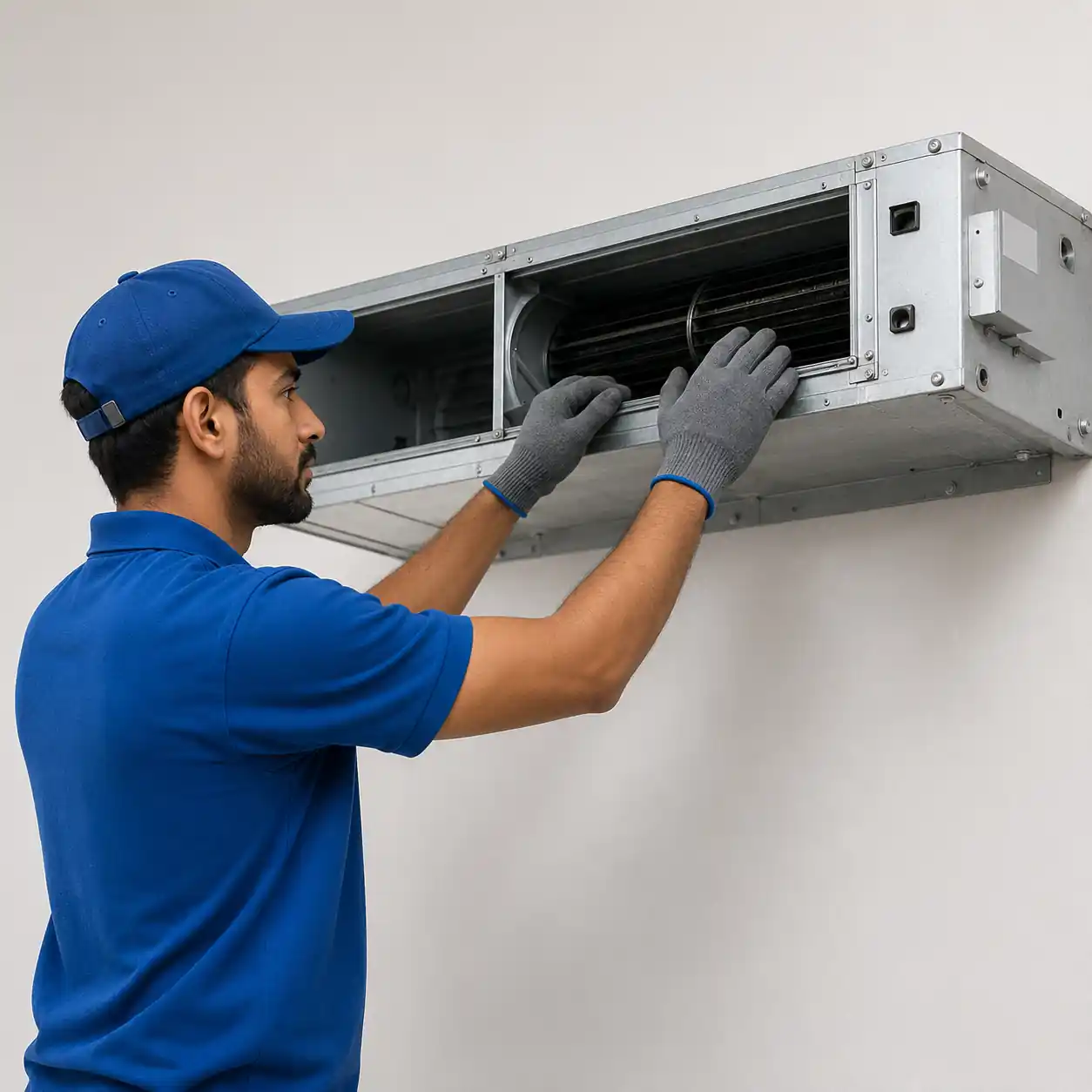
Both types hide most of their parts in the ceiling, but they need slightly different attention. Cassette units are serviced through their own front panel: filter, coil, drain tray, drain pump and louvre motor. Ductable units add return-air filters, a concealed indoor unit reached through a ceiling hatch, and the ducts and diffusers themselves. If ceiling hatches were never provided during fit-out, servicing takes longer, so it is worth fixing access once. Our cassette vs ductable maintenance guide covers this in more depth.
Managing multi-unit and multi-site offices
Once an office has more than a handful of ACs, the challenge is less technical and more organisational. A few practices make a big difference:
- Number every unit and label indoor and outdoor units with the same code, so complaints, service notes and repairs can be traced.
- Keep a unit register with brand, type, capacity, location and installation year.
- Group units by zone so servicing can be done one zone at a time.
- Agree a single point of contact in the office who receives the technician and signs off each visit.
- Review the register each year to spot units that keep failing and budget for replacement before they break down in summer.
Planning downtime without disrupting work
Coil washing is wet and noisy, so it is best done before staff arrive, in the evening or on a Saturday. Filter cleaning and electrical checks are quiet and can happen during the day, one room at a time. For server rooms or critical cabins, service the unit when a portable fan or backup unit can cover the gap, and never take all units on one floor offline at once. Our working hours of 8 AM to 10 PM, Monday to Saturday, allow early starts and evening finishes on most days.
Avoid scheduling the annual deep service in April or May, when demand peaks and a failed unit found during servicing is hardest to cover. A late-winter service gives time to order any parts before the heat arrives.
Voltage protection pays off
Voltage fluctuation is a common cause of capacitor, contactor and PCB failures in Odisha. Ask your technician whether stabilisers or voltage protection devices are suitable for your units, particularly on inverter and VRF systems.
AMC, CMC or pay-per-visit for offices?
Pay-per-visit works for an office with one or two units and someone reliable to book servicing. Beyond that, a contract usually saves effort. An AC AMC schedules preventive visits through the year, with repair parts billed separately. An AC CMC adds repair support as per contract terms, so the office has one predictable arrangement instead of per-incident billing. Read AMC vs CMC explained to decide which fits your site.
Whichever you choose, ask for a written schedule, a per-unit visit record and a clear explanation of what is and is not included. When a breakdown does happen, a contractor who already knows your units handles the commercial AC repair faster, because the history of each unit is already on record.
Frequently asked questions
Paras Refrigeration Service Team
AC service technicians, Bhubaneswar · Last reviewed 5 Oct 2026
Written by the Paras Refrigeration service team from day-to-day experience repairing, installing and maintaining residential and commercial AC systems across Bhubaneswar, Cuttack, Puri and Khordha.
- #Office AC
- #Commercial AC
- #AC maintenance
- #AMC