In this articleShowHide
If you manage an office block, hotel or hospital, you have probably heard both terms, often in the same conversation: VRF and VRV. Vendors use them as if they were different products, which leads to confusion when it is time to arrange VRF VRV AC service or compare maintenance quotes. The short answer is that they describe the same technology. The longer answer, which matters for your building, is how that technology works and what it needs to keep running.
This guide explains the naming, the working principle, and the service routine our technicians follow for these zoned systems in commercial buildings across Odisha.
VRF vs VRV: the difference is the name
VRF stands for Variable Refrigerant Flow and is the generic industry term. VRV stands for Variable Refrigerant Volume, which is a trademark of Daikin, the company that introduced the technology commercially. Other manufacturers cannot use the VRV name, so they call their equivalent systems VRF, sometimes with their own brand names on top.
Both work on the same principle. Differences between brands lie in compressor design, control software, piping limits, diagnostic tools and accessories, not in the basic idea. That is why our VRF and VRV services follow the same maintenance approach, adjusted to each manufacturer's procedures.
How a zoned commercial AC system works
A conventional split AC has one outdoor unit for one indoor unit. A VRF system connects one outdoor unit, or a bank of them, to many indoor units through a shared refrigerant pipe network. The key parts are:
- Inverter outdoor units whose compressors speed up or slow down to match the total demand from the building.
- Indoor units of different styles on one system: cassette, ductable, wall-mounted or floor-standing.
- Electronic expansion valves in each indoor unit that meter exactly how much refrigerant that zone receives.
- Branch joints that split the main refrigerant lines to each indoor unit.
- Communication wiring that links every unit, so the outdoor unit knows what each zone needs.
- Controllers, from individual room remotes to a central controller for the facility team.
Because each zone takes only the refrigerant it needs, a VRF system runs efficiently at part load, which is how most commercial buildings operate for most of the day. A conference room can be cooled hard while an empty cabin next door is idle.
Heat pump and heat recovery systems
Some systems only cool or heat as a whole, while heat recovery systems can cool some zones and heat others at the same time. In Odisha's climate, cooling-only operation dominates, but it helps to know which type you have, because heat recovery systems include extra components that also need checking.
| Aspect | Conventional split ACs | VRF / VRV system |
|---|---|---|
| Outdoor units | One per indoor unit | One or a few for many indoor units |
| Zone control | Each unit independent | Independent zones on a shared system |
| Refrigerant charge | Small, per unit | Large, shared across the network |
| Effect of a leak | One unit loses cooling | Can affect several zones or the system |
| Diagnostics | Gauges and multimeter | Also manufacturer tools and error logs |
| Typical buildings | Homes, small offices | Office blocks, hotels, hospitals |
VRF VRV AC service: what proper maintenance includes
A VRF system is only as reliable as its weakest indoor unit and its outdoor plant. Good VRF maintenance looks at three areas: the indoor units, the outdoor units, and the system as a whole.
Indoor units
- Clean filters regularly; in a busy hotel or office this may be every two weeks in summer.
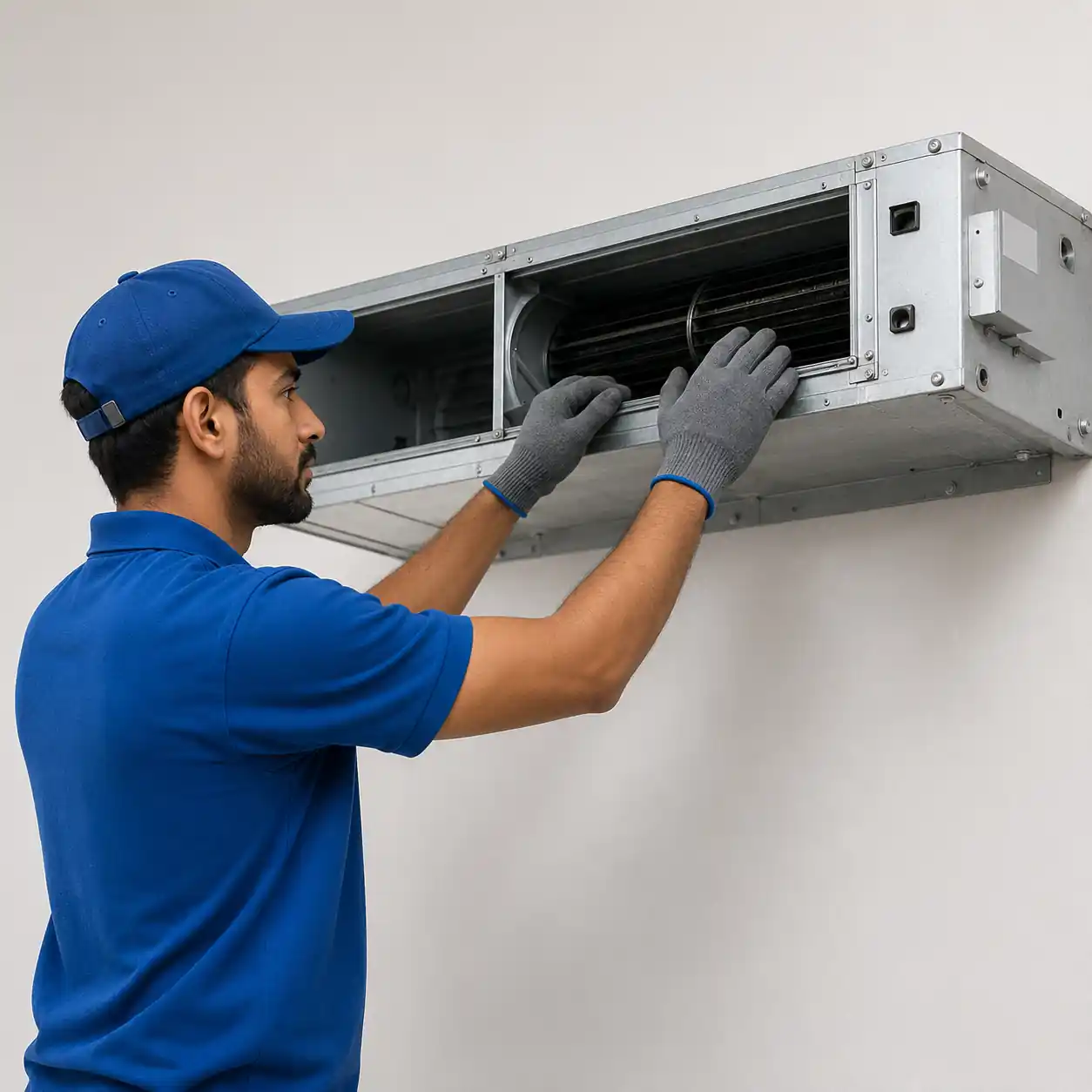
- Wash coils and blower wheels during the annual deep service.
- Test drain pumps and float switches on cassette and ducted units, and flush drain lines.
- Check louvres, sensors and room controllers for correct response.
Outdoor units
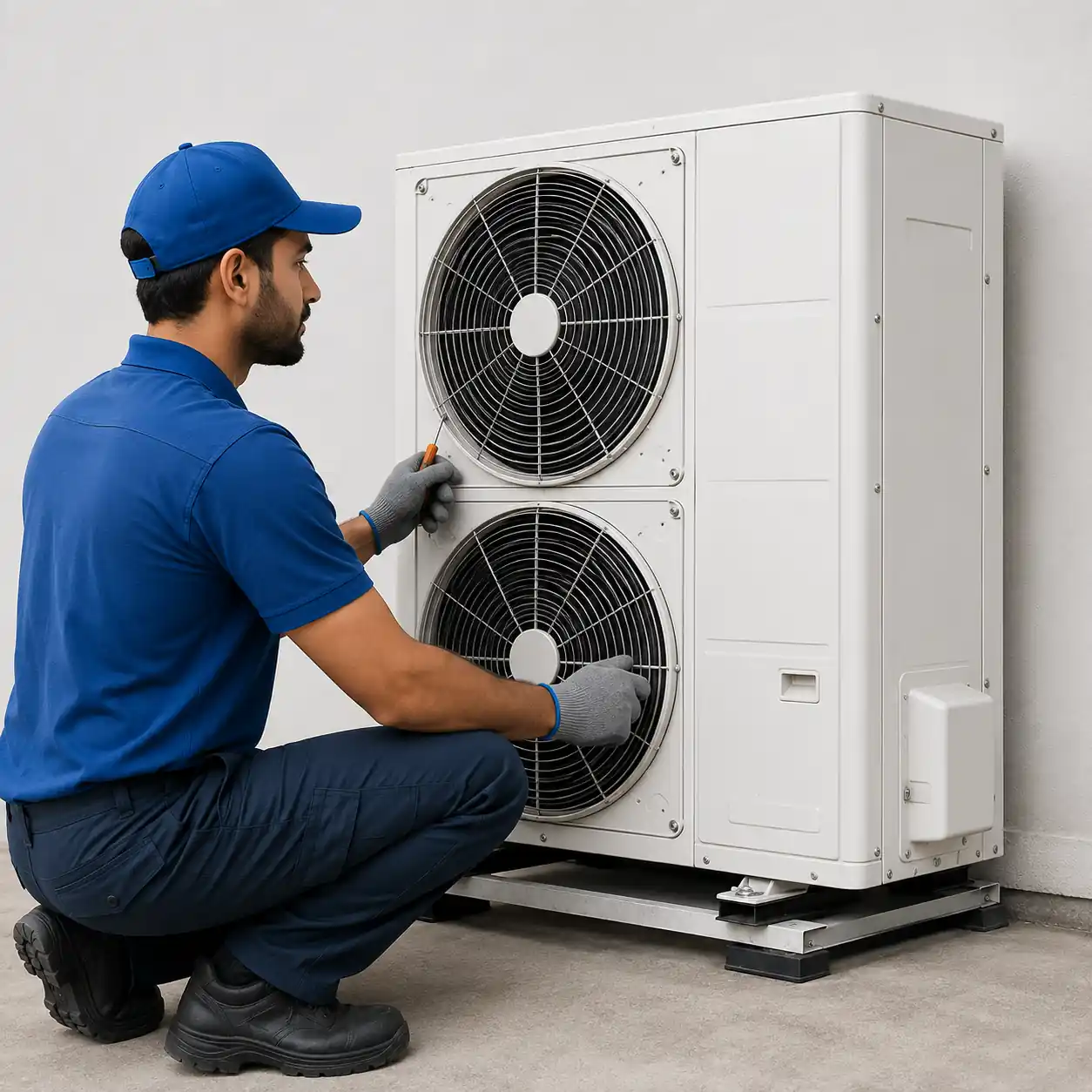
- Clean condenser coils. On rooftops in Bhubaneswar dust builds up quickly, and near the sea in Puri salt-laden air corrodes fins and needs more frequent washing.
- Inspect fan motors, blades and mountings for wear and vibration.
- Check compressor current, terminals, contactors and the inverter board area for overheating or loose connections.
- Make sure units have the airflow clearance specified by the manufacturer, and that no new structure has been built around them.
System-level checks
- Read operating data and stored error history from the outdoor unit or central controller.
- Compare pressures and temperatures with earlier visits to spot a slow refrigerant leak.
- Inspect pipe insulation, branch joints and supports, especially where pipes run through shafts and ceilings.
- Check communication wiring terminals and the power supply, including voltage balance on three-phase systems.
Never top up blindly
A VRF system's refrigerant charge is calculated for the length and layout of its pipework. Adding refrigerant by guesswork can damage compressors. If the charge is low, the leak must be found and repaired, and the correct amount recharged according to the manufacturer's method.
VRF installation: where most long-term problems start
Many faults we find years later trace back to installation. A VRF installation is closer to a small engineering project than an AC fitting, and a few steps matter more than anything else:
- Load calculation and zoning so each indoor unit suits its room and the outdoor capacity suits the building.
- Pipe sizing and routing within the manufacturer's length and height limits, with branch joints installed in the correct orientation.
- Brazing with nitrogen flowing through the pipe, so oxide scale does not form inside and later block expansion valves.
- Pressure testing the full network and holding it long enough to prove there are no leaks.
- Deep vacuuming to remove moisture, which matters a lot in humid coastal Odisha.
- Charging the additional refrigerant calculated from the actual pipe lengths, and recording the figure for future service.
- Addressing and commissioning every indoor unit and the controllers, with operating data recorded as a baseline.
Ask for the commissioning records at handover. They make every future service visit faster and more accurate.
Planning service around a running building
In hotels and hospitals, the system can rarely be switched off. Indoor unit cleaning can be done room by room, while outdoor unit work is best scheduled for early mornings or low-occupancy periods. Before monsoon, check that rooftop units are secure and that drains and electrical enclosures are protected from water. Voltage fluctuation is a recurring cause of inverter board and contactor failures in the region, so supply protection is worth discussing with your technician.
Keep a system logbook
Record every service visit, error code, part change and refrigerant addition against the unit concerned. Over a year, the logbook shows which zones are trouble spots and helps diagnose faults quickly.
For buildings with many indoor units, a maintenance contract keeps visits regular and records consistent. An AC AMC covers scheduled preventive visits, while an AC CMC adds repair support as per contract terms. For the indoor unit side, our office AC maintenance checklist sets out a monthly, quarterly and annual routine that applies equally to VRF indoor units.
Frequently asked questions
Paras Refrigeration Service Team
AC service technicians, Bhubaneswar · Last reviewed 5 Oct 2026
Written by the Paras Refrigeration service team from day-to-day experience repairing, installing and maintaining residential and commercial AC systems across Bhubaneswar, Cuttack, Puri and Khordha.
- #VRF
- #VRV
- #Commercial AC
- #AC maintenance